Monday, May 16, 2011

Gamer Dude

After Atari introduced the video game console in the 1970s the Video game market exploded. The market didn't even see its true success until the 1980s. In 1985 Nintendo introduced their new console called "Nintendo Entertainment System" to the world. The NES went on to become the best-selling video game console of all time. In the 80s people finally realized that the video game entertainment market was
going to be huge after the release of the NES. Because of this hype the market was flooded with bad games and even worse consoles. This resulted in the Video game crash of 1983. Nintendo singlehandedly brought the video game market back from the dead by selling tons of NES's.
Nintendo did this by introducing the third-party developer market to the video game market. Before this games were only being made by the consoles manufacturer. Nintendo standardized this business model which allowed other companies to release software one their console. This allowed for higher quality software to be released more often. To us now this is the norm, but back then it wasn't allowed by companies such as Atari for other companies to produce games for their console.The games is what made the NES so amazing. Not only were the first-party games created by Nintendo awesome, the third-party ones were also selling extremely well. Some of the games produced for the NES are regarded as some of the best video games ever created.
The NES was so good that Nintendo continued to produce the system for 20 y
ears even after releasing its next generations: the SNES(Super Nintendo Entertainment System) in 1990 and the N64 in
1997. Many adults viewed the video game industry as a fad after the Video Game Crash of 1983. Nintendo turned an industry otherwise forgotten about into a multi-million dollar money making machine. The NES's controller was also revolutionary. It introduced something know as a D-Pad (or directional pad) which consisted of 4 directions in which the player could choose to select. Before the invention of the D-Pad consoles often included some sort of wonky Joystick which was a pain to use as well as it being rather bulky. Nintendo won multiple awards for their controller design years after the NES debuted. The controller is now a pop culture icon. Kids grew up playing with it for hours on end and loved it like their best friend. Nearly every game system to come after the NES included some kind of D-Pad.
With one system Nintendo singlehandedly changed the video game industry forever. They changed how a game system was marketed, how it was played, how games were made, and generally how the video game console business model should function. Nintendo still continues to innovate in the video game market with co-
nsole such as the quirky Wii and new 3DS (has a 3D screen). Even though Nintendo's consoles are generally underpowered compared to their competitors they still hold the top spot in the industry with the Wii. There is no other product quite like the NES though. In my mind it still reigns supreme and I still continue to emulate some games on my computer even to this day.

Michael "Air" Jordan


If you do not know this man you SERIOUSLY need to free yourself from the house or at least turn on the T.V. Michael Jordan is the greatest basketball player to ever live. Some say he may even be the best athelete to play any type sport in history. The great Magic Johnson once said "There is Michael Jordan and then there is the rest of us." The great Larry Bird would describe Michael Jordans performance dropping 63 points on the Boston Celtics as "God disguised as Michael Jordan."
Here is a brief description of Michael Jordans accomplishments. Rookie of the year, five-time NBA MVP, six time NBA champion, six-time NBA finals MVP, ten-time all NBA first team, Nine-time all NBA defensive team, Defensive player of the year, 14-time nba all-star, three-time NBA all-star MVP, and ten scoring titles including 7 that matched the great Wilt Chamberlain although playing against better competition than Wilt. Jordan then retired with the highest all-time NBA scoring average of 30.1 ppg.
However, his impact is much more than awards and championships. He bursted into the league as a rookie sensation unlike anyone had ever seen. He scored in droves with an unmatchable first step and acrobatic drives and dunks which concluded his career as a cultural icon. He became a true champion who spearheaded the globalization of the NBA with his dynamic on court abilities and personal sense of style that was marketed to the masses.
In 1984 Nike presented Jordan with an offer. One that he was not to enthusiatic about at first saying "I can't wear those shoes, those are Devil colors." Through the meeting it is reported that Jordan seemed disinterested and bored but as he left the meeting he said to his agent "Let's make the deal."
Jordan not only changed the basketball world but with the help of Nike would completely change the fashion world as well. Some people beleive that Jordans deal is what made Nike what it is today. In my eyes there is nothing that can compare to the fashion statement that Nike or Nike Air Jordan makes. They have been among the best selling basketball shoes since their creation in 1985. The latest model of the basketball is the Jordan 21's. People speculate that they will stop making Jordans after the 23 shoe in honor of the man who started it all. Either way there has never been anything quite like the style of "Air" Jordan.
Today Michael Jordan has many different partners in business, is the owner of the Ohio Bobcats, and has an estimated net wort of $525 million. The world would not be the same with out Michael Jordan. Michael Jordan set the bar for greatness which I doubt will ever be reached.

Success and Failure for WKRP

During its 1978-82 run on CBS, WKRP in Cincinnati was one of the most critically acclaimed television programs on the air and won numerous accolades. Indeed, the sitcom won a Humanitas Prize -- an award intended to honor television shows that "promote dignity" -- and was nominated three times for Outstanding Comedy Series in the Emmy Awards. However, much of the popular success of WKRP did not come into fruition until the show aired in syndicated reruns, long after its run ended. Indeed, while the program was on the air in the late 70's and early 80's, its ratings fluctuated. At the beginning of its run, the show's initial eight episodes - despite featuring such later-beloved episodes like "Turkeys Away" - performed poorly in the ratings. Consequently, WKRP was put on hiatus shortly thereafter. Nevertheless, the clamor of disc jockeys across the country and TV critics -- who admired the show's witty humor -- helped resurrect the sitcom.


Ultimately, suspecting that WKRP could bear auspicious fruits for CBS, the network gave the sitcom a golden spot in their primetime schedule. The new time slot of WKRP was as the follow-up to the extremely popular comedy, M*A*S*H. Believing that the sitcom would attract viewers who were watching M*A*S*H, the decision from CBS was seemingly logical and rational. Consequently, show creator Hugh Wilson exploited the opportunity to adjust his sitcom's subject manner to include more dramatic plots to reflect the time change from CBS. The lead-in to the show, M*A*S*H, while essentially a sitcom, was nonetheless known for grappling grave and controversial topics. Therefore, Wilson saw it as appropriate to take advantage of the time slot change to develop more dramatic episodes such as one that revolved around the DJ Venus Flytrap's desertion from the U.S. Army. However, Wilson was deprived of the opportunity of making his show a megahit. During the second season, CBS moved WKRP yet again to a new timeslot earlier in the day, a decision that left producers and writers wondering what material would be appropriate for the new timeslot, considered the "family hour." As a result of even more changes in its time slot, WKRP saw its ratings decline -- with the notable exception of the finale earning #7 among all TV shows in Nielsen ratings -- and by 1982, the show was off the air.


Despite the troubles WKRP faced in its run, the show has earned several accolades and become more massively popular in reruns than anticipated. The sitcom was nominated for 10 Emmy Awards, including a win by Andy Ackerman for the Emmy for Videotape Editing in season three. The show's "Turkeys Away" episode was listed several decades later by TV Guide as one of the greatest television episodes of all time. Furthermore, in syndicated reruns, WKRP became so popular during the 1980's that it performed better in the ratings than all of the other sitcoms of MTM Enterprises running on the air at the time. In fact, the reruns were frequently placed among the highest-rated syndicated shows on television during the 1980's alongside hits like Wheel of Fortune. The popularity of the reruns helped inspire a spin-off to the show, The New WKRP in Cincinnati during the early 1990's, yet this sitcom was a ratings disaster. Ultimately, even though the sitcom failed to find significant popular success during its time on the air, it has won numerous awards and found ratings glory since its run ended.


SOURCES:

1. WKRP in Cincinnati - Wikipedia, the free encyclopedia - en.wikipedia.org/wiki/WKRP_in_Cincinnati

2. WKRP in Cincinnati - The Internet Movie Database - www.imdb.com/title/tt0077097/

3. WKRP in Cincinnati - An Episode Guide - www.epguides.com/WKRPinCincinnati/guide.shtml


IMAGES:

1. Wikimedia.org

Monday, May 9, 2011

Run (With It) DMC


Run D.M.C unlike any other hip-hop group is responsible for both the sound and style of the music. They were the first harcore rap group and set the foundation for the next decade of rap. With their heavy metal excurisons and there spare beats, the trio was tougher and better than their predecessors Grandmaster Flash and Whodini. They opened up the doors for the politicized rap of Public Enemy as well as the gangsta fantasy rap of the N.W.A. They were the first hip-hop artists to construct full-fledged albums, a huge step in the hip-hop culture. By the end of the 80's Run D.M.C. had been taken over by groups they had spawned, but they continued to perform well into the 90's.


All three members of Run D.M.C. were natives of middle-class New York borough Hollis, Queens. "Run" aka Joseph Simmons was the brother of Russell Simmons who formed the hip-hop management company Rush Productions in the early 8 0's, and by the mid 80's Russel had formed the pioneer record label Def Jam with Rick Ruben. Russel encouraged his brother Joey and his friend Darryl McDaniels to form a rap duo. It was time to start a revolution and they adopted the rap names Run and D.M.C. After they graduated high school in 1982, the pair enlisted their friend Jason Mizell to scratch turn tables. Jason adopted the stage name Jam Master Jay.


In 1983 Run-D.M.C. released their first single "It's Like That"/"Sucker M.C.'s," on Profile Records. This sounded like no other rap song at the time. It was blunt, skillful, with hard beats and powerful, daring vocals where Run and D.M.C.'s vocals overlapped as they finished each others lines. It was the first to a new era. "It's Like That" became a top 20 R&B as did the groups second single "Hard Times"/"Jam Master Jay". Two other hit R&B single's followed in early 1984 "Rock Box" and "30 Days"


In 1986 Run D.M.C. set up for arguably their most popular song ever a cover of"Walk This Way" recorded with Aerosmith's Steven Tyler and Joe Perry. The album the song was recorded on Raising Hell became the first Rap Album to become number one on the R&B charts, to chart in the Pop Top Ten, and go platinum.


In 2002 a few weeks after a greatist hits tour with Aerosmith Jam Master Jay was senselessly murdered in a studio session in queens. Jam Master Jay's new sound and beats will never be forgotten because he helped set the foundation for today's new style of music, Rap.


http://www.sing365.com/music/lyric.nsf/run-d-m-c-biography/7b157ca64417644c482568a900012a44


Origin of and Success of Billie Jean

An enormously sucesssful single in American music history, "Billie Jean," performed by the legendary Michael Jackson in 1982, contains unusual lyrics that - while extremely popular -remain a mystery. Indeed, numerous different accounts have been offered to explain the story behind "Billie Jean," including from the rumor mill, Jackson's biographer, and the late Jackson himself. Although the lyrics and the easily recognizable bass line of the song made it a favorite of Jackson, who insisted it would be success, contradicting the concerns of song producer Quincy Jones. Ultimately, the song's popular music video, appealing musical elements, and creative lyrics validated Jackson, who oversaw the rise of the song to #1 on Billboard's Hot 100 Chart for seven consecutive weeks.


Outside of the accounts offered by Jackson and the late musician's biographer regarding the origins of the lyrics of the song, there exist popular rumors regarding the lyrics that claim the song revolves around tennis superstar Billie Jean King. In spite of the popularity of these rumors, these claims are likely false due to her sexual orientation. An explanation of the lyrics -- which tell the story of a man who had a sexual relationship with a young woman with whom he consequently fathered a child -- offered by Jackson in his 1988 book, Moonwalk, only fuel the ambiguity and mystery. Indeed, Jackson recounted that, "Billie Jean is kind of anonymous...[and] represents a lot of girls...they would hang around backstage doors, and any band that would come to town they would have a relationship with." However, Jackson conceded a personal connection as well, indicating that "there were a lot of Billie Jeans out there...every girl claimed that their son was related to one of my brothers." Expressing frustration with this development, Jackson penned that he "could never understand how these girls could say they were carrying someone's child when it wasn't true." Nevertheless, Jackson's explanation is disputed by his biographer, J. Randy Taraborrelli, who contends in The Magic & The Madness that a would-be pyschiatric patient would frequently send letters to Jackson insisting he was the father of one of her children. Taraborrelli claims these letters caused nightmares for Jackson, terrified by the woman's inclusion of a gun in a letter in which she said that it could be the case they would be lovers in afterlife.


Although the origin of the lyrics certianly remain a mystery, what is not in question is the huge popularity, success, and cultural impact of "Billie Jean" in the music industry. Although producer Quincy Jones did not appreciate the bassline and the demo, Michael Jackson claimed from the start that he "knew it was going to be big when" he was "writing it." Jackson was vindicated. "Billie Jean" reached the top of the R&B chart in three weeks, reached number nine on the Hot Adult Contemporary Tracks chart, was the third best selling single of 1983 in the United States, was praised by Rolling Stone and Blender, and earned eight accolades at the 1984 Grammy Awards. Recently, the song attained #58 on Rolling Stone's 500 Greatest Songs of All Time.


SOURCES:


1. Billie Jean - Wikipedia, the free encyclopedia; en.wikipedia.org/wiki/Billie_Jean

2. Book Review: "Michael Jackson Revisted but Not Revealed" - Justin Moyer, August 4, 2009

3. MTV.com - "Michael Jackson Answers Fan Questions in 1996 Thailand Interview," July 6, 2009


PICTURES:

1. Wikimedia - en.wikipedia.org/wiki/Billie_Jean

Sunday, May 8, 2011

Steve Jobs Pushing Computing Forward

Some people think he is crazy, some people think he is a visionary who has revolutionized many aspects of the electronics industry. Steve Jobs has consistently been pushing technology forward since founding Apple Computer in 1976. At first himself and Steve Wozniak revolutionized what people thought a computer was with the Apple I. Even though the Apple I was extremely primitive, it was still revolutionary for its time. Quickly seeing a market for personal computers, Woz and Jobs released the more commercialized Apple II. The Apple II launched with a "killer-app" called VisiCalc Spreadsheet. This app created large potential for the Apple II in the business world and increased its success. This is similar to the apps on the iPhone today, which are consistently driving sales. As IBM entered the PC market, the Apple II's market share began to dwindle. Jobs then set out to create Apples next revolutionary product. This product was the Macintosh.

The Mac singlehandedly revolutionized the personal computer by introducing the Graphical User Interface. This

used graphics instead of typing commands to preform tasks on the computer. This opened the door for even more people to own their own and operate a personal computer. Jobs didn't stop there. When he returned to the company in 1997 he introduced another revolutionary product called the iMac. Jobs saw the immense potential of the Internet and saw it fit to include a Ethernet port on the iMac in preparation for the web revolution to come. The 'i' in the name stood for Internet, so Jobs was essentially gearing the device to a market that hasn't been fully developed or popularized yet. The iMac also only had firewire and USB ports on it, removing the old Serial ports which was used to connect peripherals to computers for years. He was essentially setting the bar for other computer manufacturers to follow in the following years. The iMac also "revolutionized" computer design. At the time computers were usually big beige boxes which had to be connected to a separate monitor to function. The iMac featured an AIO(all-in-one) design which included the monitor and case in one unit. The design was also translucent and offered "candy" colors which made the computer not only extremely functional but also some sort of fashion statement. The iMac was designed by young Industrial Designer Johnathan Ive. Ive had done much research on colors at candy factories and took months to get both the colors and amount of translucency up to Jobs' high expectations for the product. The design of the iMac alone would have made it a revolutionary product.

Then in 2001 Steve Jobs introduced the iPod, Apples entry into personal music player market. Jobs had a vision that CD's would be essentially obsolete and people would be listening to all digital music. The iPod let you carry your entire music library in your pocket. The iPod wasn't the only digital music player when it was released but it was definitely the best designed one. Yet again Jobs let Johnny Ive design another revolutionary product. The design eventually became one of the most recognizable designs of the 21st century. The design was so elegant and complemented the software extremely well. A year later Jobs released the revolutionary iTunes music store which allowed people to digitally download music to use on their iPods. Jobs was able to convince all three major US labels that digital downloads were the future of the music industry, and a power to defeat the file-sharing networks such as Napster and Kazaa. iTunes is now the #1 retailer of music in the US.

Jobs kept pushing many new technologies forward such as multi-touch screens. The iPhone was released in 2007 and wasn't the first device to have a multi-touch screen but it was the one that did it the best. Since then the iPhone has been revolutionizing how people think about their cell phones. Jobs realized that software was a huge deciding factor in an Operating Systems overall success. Because of this he opened the App Store in 2008 which led to hundreds of thousands of apps to flood the mobile market. Apple now has the largest catalog of apps and because of this they continue to have one of the

worlds most popular cell phone, the iPhone. These killer apps continue to keep Apple atop the mobile market.

It seems like no matter what Jobs does the world watches and then follows. He has changed many industries and continues to make his mark on the world. No matter what decision Jobs makes it always seems as though he thoroughly thinks about each one. With every product he releases he essentially attempts to out innovate the "rest".


Sunday, May 1, 2011

Match Game

During the 1970's, groundbreaking television that touched on controversial subjects such as race, sex, and out of wedlock pregnancy dominated networks. Sitcoms that dealt with these topics included All in the Family -- one episode included Sammy Davis, Jr. kissing the bigoted Archie Bunker -- and Three's Company, a series that revolved around single bachelor Jack Tripper pretending he was gay in front of his landlord in order to live with two young girls. However, not only did sitcoms enter uncharted territory but so too did game shows, especially in the case of Match Game.


In 1973, Mark Goodson and Bill Todman, legendary game show producers, brought to CBS a revival of The Match Game, a bland game of simple fill-in-the-blanks involving celebrities and contestants that ran from 1962 to 1969. While revived edition of the show was renamed Match Game '73 in order to reflect the year, the program still featured the zany Gene Rayburn as host. In an unusual development, Match Game '73 skyrocketed to even greater popularity than the original 1960's program. Within weeks, the show became the #1 highest rated program on daytime television. During the 1973-74, 1974-75, and 1975-76 seasons, Match Game remained at #1 in daytime TV, earning extremely high ratings, especially in the 12-34 year old demographic. The program was also the most popular game show on TV from 1973 to 1977 and the #2 most watched game show in the 1977-78 season as well. Airing in the 3:00 p.m. hour, the game show was particularly adored by teenage fans who rushed home from school to catch the program. A key element of this incredible success was the show's tendency to include sexual double-entendres in fill-in-the-blank questions and its pushing of the boundaries in terms of celebrity and contestant responses to questions.


This version of Match Game was heavily influenced by a set of comedy writers on the production team. Among these writers was Dick DeBartolo, who also wrote for the comedic Mad magazine. DeBartolo and his team of fellow writers penned often hilarious and racy fill-in-the-blank questions that left the audience laughing. These questions included, "Contrary to popular belief, Eve was not made out of Adam's rib but was instead made of Adam's _____" or "The big bad wolf said, 'I just came from a house where this old lady had the biggest _____s I ever saw!'" After Rayburn would read such a question, celebrities would proceed to write down answers in secret and if a contestant's subsequent answer to the question matched the responses of celebrities, the contestant would earn one point per match. The contestant with the highest number of matches after two rounds would win $100 and proceed to a second round featuring an audience survey. These questions naturally made the Standards and Practices Department at CBS nervous. Consequently, CBS agreed to permit Match Game contestants and celebrities to use words such as "boobs" and "derierre" in response to questions but barred the use of more explicit words, including any references to genitalia.

The fact that contestants and celebrities were permitted at all to use words such as "boobs" was an extaordinary development given the long history of the network's Standards and Practices Department being sensitive to such language on television. Nevertheless, CBS was still incredibly cautionary in its monitoring of Match Game. When Gene Rayburn accidentally quipped in 1974 that a contestant had pretty 'nipples,' intending to instead say 'pretty dimples,' the network refused to air the error. However, CBS restored the clip, which has been relayed on countless TV specials of game show bloopers. When a celebrity panelist used a word in a response that was considered to racy by Standards and Practices, the reply was often censored on the screen.


The groundbreaking quality of the questions and their replies, combined with the excellent comedic chemistry of Rayburn and the celebrity panelists, catapulted Match Game to enormous success. The program was nominated several times for a daytime Emmy award for Outstanding Game Show, earned #10 on TV Guide's 2001 list of the 50 greatest TV game shows of all-time, and was named the #1 greatest game show of all time in GSN's list of 50 greatest game shows in 2006. Host Gene Rayburn -- an emcee who engaged in acts like climbing the audience, knocking down the doors, roller-skating on stage, and belly dancing with a contestant -- was nominated for a daytime Emmy award for Outstanding Game Show Host and earned a Lifetime Achievement Award from the Academy of Television Arts and Sciences in 1999. Today, the popular game show of the mid-1970's lives on in cable reruns as it has long held the title of the #1 most watched show on GSN's schedule.


SOURCES:


1. Match Game - Wikipedia, the free encyclopedia - en.wikipedia.org/wiki/Match_Game

2. Match Game '73 - IMDB - www.imdb.com/title/tt0069608/

3. Match Game - GSN - The Network for Games - www.gsn.com/shows/matchgame

4. Gene Rayburn, former 'Match Game' host, dead at 81, December 2, 1999 - CNN Archives - www.cnn.com/1999/SHOWBIZ/TV/12/02/obit.rayburn.ap/index.html


IMAGES:

1. Nypost.com

2. en.wikipedia.org/wiki/Match_Game

3. The New York Times, "The Real Match Game Story: Behind the Blank," November 25, 2006; http://www.nytimes.com/

The time of the Disco


As the 70’s came along, the disco scene began to thrive. The popularity of discos peaked during the mid to late 1970s. By the late 1970s most major U.S. cities had thriving disco club scenes, but the largest scenes were in San Francisco, Miami, and most notably NYC. The roots of the disco can be traced back to black, gay, psychedelic and other various communities mostly in in the NYC area. Disco was used as a reaction against both the domination of rock music and the beginning of dance music during this period. Women embraced disco as well, and the music eventually expanded to several other popular groups of the time.

Disco DJs played "a smooth mix of long single records to keep people dancing all night long.” Some of the most prestigious clubs also had elaborate lighting systems that throbbed to the beat of the music. The typical disco songs usually had a soaring, often reverberated vocals over a steady four-on-the-floor beat, an eighth note or sixteenth note hi-hat pattern with an open hi-hat on the off-beat, and a dominant, syncopated electric bass line. Various sounds and instruments such as strings, horns, electric pianos, and electric guitars were used to create a lush background sound. Orchestral instruments such as the flute were also often used for solo melodies.

In addition to the huge popularity of the disco, the increase in drug use and sex drastically increased. Disco goers would enhance the experience of dancing to the loud music and the flashing lights with various drugs such as cocaine “blow” and amyl nitrate which was known as “poppers.” To make the “disco” experience even better, disco goers would have sex in the clubs. While the dance floor was the central arena of seduction, sex usually took place in the “less crowded” areas of the disco such as the bathrooms, stairwells, and even the balconies. A perfect example of a club that would have these experiences on a “daily basis” was Studio 54. Studio 54 was arguably considered to be the most well known club in the world. It was so popular that it even played a major role in the growth of disco music and nightclub culture in general.


When the 80s rolled around, the popularity of discos in the United States declined markedly as a result of a backlash. Although it began to be quite unpopular in the United States, it continued to grow elsewhere in the world. The word “disco”was soon replaced by "dance music" and "dance pop.” In the decades since, dance clubs have remained highly popular and influential, and the disco beat has even informed the sound of many of music's biggest stars. The disco was not only a dance, but it was a music, a fashion, and a lifestyle.

sources-
http://en.wikipedia.org/wiki/Disco
http://www.saskschools.ca/~nlsd/grassroots/life/dance/docs/disco.html

The Return of the Festival


Large scale music festivals were a relatively new concept in the 1960's and 1970's. Although there have been smaller festivals for years all across the United States it wasn't until the 1960s when this scene exploded. The most notorious music festival seems to be the Woodstock Music and Peace festival. This took place in the small farming town of Bethel New York in August 1969. This festival drew an excess of 500,000 people to the small town. This monumental event sparked interest in music and art festivals across the World. Music festivals during the late 1960s and 1970s showed the world just how powerful musicians were. To draw such big crowds of especially younger people it showed how big of an influence music had upon their lives.


Although festivals and festival culture seemed to die off in the 1980s and 1990s it has made
an astonishing return within the last decade. It must be that the economy that is causing many music fans to go to festivals rather than seeing their favorite bands individually. For example a 3-day festival ticket could cost you about 200-300 dollars whereas a single concert ticket could range anywhere from 70-1000 dollars for a single show. This has caused an increase in the number of festivals in the US along with festival attendance. In the past few yea
rs concert attendance has declined but festival attendance has steadily increased. Many popular festivals in the United States include ULTRA, Bonnaroo, Coachella, Burning Man, SunFest, Lollapalooza, DMB Caravan, Bamboozle and numerous others. Each has their own interesting list of headliners and supporting acts. The interesting lineups keep bringing more and more young people to festivals every year.

I am actually going to the DMB Caravan festival in Atlantic City this summer. It's taking place at Bader Field which is actually an abandoned airport. The location reminded me of the Rolling Stones concert at Altamont Speedway. This is going to be my first festival experience and I can't wait to see all my favorite acts along with seeing some new ones. I think the amount of variety in festivals draws young people like me to them. Along with their bargain pricing its hard for a young person interested in music not to want to attend a festival. Festival culture has changed alot since the 1960s and 1970s. Festivals have been alot harder on illegal drug and alcohol use than they were back in the day.

Sunday, April 17, 2011

Television in the 1960's

Despite the popularity of dramas like Gunsmoke and game shows such as Password, comedies were still the most prevalent and popular programs on television. Two such sitcoms in particular -- The Dick Van Dyke Show and Rowan and Martin's Laugh-In -- were incredibly popular and very well-received by American TV audiences and critics. Presented in times of strife and struggle, amid tragedies such as the assassination of President Kennedy and the prolonging of the Vietnam War, these shows often appealed to the public desire to escape from trouble by seeking laughter. Indeed, these programs saw particularly stellar ratings during especially trying times for Americans. The Dick Van Dyke Show earned the #3 spot in Nielsen ratings in the 1963-64 season, a time mired by JFK's assassination, while Laugh-In rose quickly to #1 in the ratings in the 1968-69 season, a time marked by the Tet Offensive, the assassinations of Robert Kennedy and Martin Luther King, and demonstrations at the Democratic National Convention. This reality is seemingly part of a broader pattern in American television history. When times become tough, Americans typically turn to laughter as appropriate medicine. In fact, during the Iran Hostage Crisis and stagflation of the Carter era, the sitcom Three's Company was the #2 most popular show on TV (1979-80) while Friends became the most popular program in the 2001-02 season amid the 9/11 attacks and their aftermath.


Rising to a high spot in the ratings by the time a similarly terrible tragedy struck, The Dick Van Dyke Show was a critically acclaimed sitcom focusing on a pictureesque suburban American family. A winner of 15 Emmy Awards, the show focused on Rob Petrie -- played by Van Dyke in spite of an original inclination to give the role to Johnny Carson -- who was the chief comedy writer for The Alan Brady Show, a fictional TV variety program. In the sitcom, Rob is married to Laura Petrie, an independence-craving, stay-at-home housewife - played by Mary Tyler Moore - and works alongside the jocular Buddy Sorrell (Morey Anderson) and the sexually frustrated Sally Rogers (Rose Marie) at his office. By the second season of the show (1962-1963), the sitcom jumped to #9 in the ratings, catapuled to #3 by the next season, #7 in the 1963-64 season, and #16 in the 1964-65 season. Although popular throughout its tenure, producer Carl Reiner insisted that the show end after five seasons as his vision of the program consisted of Rob Petrie spending the entire run of the show writing his memoirs for five years and then submitting them to be eventually turned into a variety show at the end of the series. Featuring much physical comedy from Van Dyke and mocking 60's cultural staples like Invasion of the Body Snatchers and The Beatles in numerous episodes, the sitcom was very popular.
Similarly popular was Rowan and Martin's Laugh-In, named for comedians Dan Rowan and Dick Martin, the hosts of the popular variety program. Premiering on January 22, 1968, amid the rising unpopularity of the Vietnam War, the show popularized comedy sketches that skewered politicians and included sexual innuendo. The subject matter of these sketches and skits - the main thrust of the program - clearly earned the adoration of viewers and critics alike. From 1968 to 1972, the show never fell out of the coveted echelon of the top 20 highest-rated TV programs, even earning the #1 spot in the Nielsen ratings in both the 1968-69 season and the 1969-70 season. At the height of its popularity, nearly 19 million Americans tuned in to the show. The program also won several Emmy awards, including for Outstanding Musical or Variety Series. Such an 'outstanding' variety series included Rowan and Martin offering an opening monologue where they played in character, a segment mocking the evening news (an early precursor to The Daily Show with Jon Stewart), a segment featuring bizarre talents, and an extremely popular segment featuring actress Judy Carne ravished with water after she said, "Sock it to me." In fact, in the course of TV history, the singular phrase that is often associated with and will often define Laugh-In is "Sock it to me." The show even featured President Richard Nixon, then the Republican nominee for the White House, saying the line, "Sock it to me?" - as a question - during the 1968 campaign. Ultimately, the show was both controversial -- a 1971 episode mocking the FBI was thoroughly investigated and reviewed by the bureau -- and groundbreaking, helping lead to the success of Saturday Night Live, The Gong Show, and The Daily Show with Jon Stewart.


PICTURES:


2. static.tvtropes.org/pmwiki/pub/images/laugh-in.jpg

Just Skatin' Bro

Skateboarding history can be traced back to the 50s and 60s, where the sport evolved as a fun activity for the younger crowd and teens in California. In these early days of skating, skateboards were all homemade and made of wooden planks that were attached to roller-skate trucks and wheels. Skateboarding was not even known as skateboarding yet, but instead as “sidewalk surfing.”


The best skaters of the time, such as Torger Johnson, Woody Woodward and Danny Berer, were guys who simply imitated the styles and moves of the top surfers. Slalom or freestyle were some of the popular skateboarding tricks practiced during those times. These styles of the skaters were more simple and not very adventurous.


As the 60's progressed, skateboarding began to really take off. There were now skateboard manufacturers such as Hobie and Makaha, which were actually top surfing companies. Much of their products were very similar to surfboards of the time. Skateboarding became so popular that even a magazine was created dedicated to following it. This magazine was known as Skateboarding Magazine. There was even an international skateboarding championship in 1965 that was telecast on national television. Skateboarding was doing so good that the growth of the sport during this period can shown by the sales of Makaha boards. Nearly $10 million dollars worth of boards were sold in a 2 year span. Skateboarding was really "taking off." Although this is remarkable, skateboarding began to take a huge dip in the coming years. By 1965, the skateboard fad was over and began to rapidly decline. Experts of the time pronounced that skateboarding was very unsafe. They urged stores not to sell them, and parents not to buy whatsoever. Due to this, all sales dropped significantly and the only skateboarding magazine was disbanded. This hit was considered to be the biggest hit in skateboarding history. The 1970's would experience some popularity, but not until the 1980's was when the popularity of skateboarding went off the charts. A whole new era of skateboarding was about to begin..

The Amazing Wilt Chamberlain


Wilt Chamberlain was born in Philadelphia, Pennsylvania. He was one of nine children raised by William and Olivia Chamberlain. They lived in a racially-mixed middle class neighborhood, so Wilt enjoyed a relatively pleasant childhood. Wilt began to play basketball at Shoemaker Junior High School. He also played at the local playgrounds with the older kids who would teach him a lot about the game. Wilt would later say that "I still think you could pick up a team from the street corners of Philly that would give most colleges a real hard time." Wilt attended Overbrook High School in Philadelphia beginning in 1952. At that time he was already 6'11" tall and had already developed a "deep love for basketball."


Chamberlain's high school basketball career was more than astounding. In just three seasons he scored more than 2,200 points. As a result there were more than 200 colleges recruiting Chamberlain. Wilt had always wanted to get away from the cities and move to the Midwest so he commited to the University of Kansas to play for the legendary Hall of Fame coach Phog Allen. At Kansas Chamberlain continued to dominate on the basketball court. In his very first varsity game he scored an unbeleivable 55 points. He lead the Jayhawks to the NCAA championship his first year where they would lose to the North Carolina Tarheels in double overtime. During his college career he averaged over 30 points a game and was selected to two All-American teams. Following his Junior Year Chamberlain decided to quit college and go professional.


Because Chamberlain did not play his final season at Kansas he was not eligible to play in the NBA just yet so he decided to join the Harlem Globe Trotters. He later claimed that his year with the Globe Trotters was his most enjoyable season of basketball. In 1959 Wilt joined the Philadelphia Warriors and made an immediate impact on the league. He could score almost at will. Opposing teams gave up trying to stop him and instead just tried to contain him. His scoring average in his first season in the NBA was 37.9 points per game. This is more than 8 points per game higher than anyone else in the history of the league had ever scored. He was named Rookie of the Year and Most Valuable Player of the Year, the first person to ever do both in the same season. For the next six seasons Chamberlain led the league in scoring. In the 61-62 season he averaged 50.4 points a game and scored 100 points in one game. These are both NBA records which still hold to this day. Chamberlain was simply one of,if not the greatest scoring machines in the history of the NBA.


In 1967 Chamberlain was traded to another Philadelphia team the 76ers. The 67' 76ers finished their season with the best record in the history of the league. In the championship series the 76ers humiliated the San Francisco Warriors to win the first world title for Chamberlain. Several years later Chamberlain was traded again to the Los Angeles Lakers. The Lakers have not won a championship since moving to Los Angeles in 1960 but in 1972 the Lakers seemed to be poised and ready enough to win an NBA championship. In the fourth game of the series Chamberlain suffered a fractured wrist. Although the Laker lead the series three games to one it seemed unlikely that they would win the series due to Chamberlain's injury. Despite understandable pain Chamberlain played the next game with football lineman gloves on each hand. He scored 24 points, grabbed 29 rebounds, and blocked 10 shots. The Lakers won the game and the series four games to one bringing the Los Angeles Lakers their first world championship.


Following the 1973 season Chamberlain left the NBA as the all-time leader in points scored with more than 30,000 and rebounds with over 22,000. He held four mvp awards and over 40 NBA league records. After retiring from basketball Chamberlain was involved in many activities. He sponsored several amateur athelete groups including volleyball teams and track clubs. He invested wisely through the years and spent his retirement years as a wealthy man. When this man would walk into a room or on to a basketball court you can feel the legendary presence.


L ucy in the S ky with D iamonds


The Beatles weren't the only people experimenting with LSD in the 1960's. LSD is a hallucinogen and was first synthesized in 1938 in Germany. Before the 1960's LSD was being used to treat a multitude of mental illnesses. LSD was legal in most areas during the 1960's. The first state to ban the drug was California in 1966 shortly followed by the rest of the United States. The drug began to be used recreationally in the 1960's by doctors taking it themselves and sharing it with their friends.

After the Beatles admitted to taking the drug, the drugs popularity skyrocketed. The Beatles were the "it" group of the time and since LSD seemed to enhance their songwriting skills others thought it would do the same to them. The Beatles song "Lucy in the Sky with Diamonds" is a very psychedelic song which seems to be about LSD as the letters in the name suggest. The drug is said to produce unpredictable results for each user. There are different factors such as mood, environment, and dosage that effect the results of an LSD trip.


Sunday, April 10, 2011

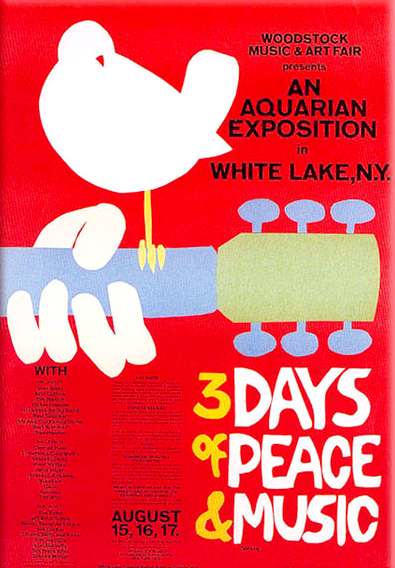
Woodstock 1969-a weekend of music, love and peace


In August of 1969, one of the most celebrated music festivals in history took place in Bethel, New York. This festival was known as "An Aquarian Exposition: 3 Days of Peace & Music," or simply Woodstock. The three day festival was all about peace, love, understanding, music, and some serious partying. It was a historic event of the 60’s that changed many peoples view on life and was a big part of what is known as the hippie movement.

At a time when Americans were deeply divided, an unprecedented amount people from across the country gathered in the fields of Bethel to celebrate the "Three Days of Peace and Music." The three day festival
was originally designed in order to make money, but that did not end up happening. The promoters only expected a showing of around 100,000 people, with a max of nearly 200,000. Shockingly, that was not the case. There were nearly 500,00 in attendance and because of this, the festival became free. By having so many people in attendance meant that problems were bound to occur. Problems such as traffic jams, lack of food, water supply, sanitation, and medical care all arouse. Although these challenges arouse, they did not stop the people of Woodstock from having fun.

When one thinks of Woodstock, they immediately think of drugs. Marijuana and LSD immediately come to thought as they were the most common drugs used at Woodstock. Although this may be the case, the usage of drugs brought people at Woodstock closer together. By taking something that was socially unacceptable and using it in such a blatant way to promote an even more unacceptable lifestyle, they believed that they had found a way to have fun and become closer together while protesting. Whether they used drugs to promote the peace and happiness, protest, or even just because they enjoyed it, drug usage was a huge part of the hippie sub-culture at Woodstock.


At the Woodstock festival, there were many influential musicians who performed. Musicians such as Jimi Hendrix, Janis Joplin, The Who, and the Grateful Dead all preformed. It was considered a great honor to preform. Some musicians who rejected to show up soon regretted that decision. The Beatles and Bob Dylan are a few that declined the invitation to preform. They never thought that Woodstock would be so big and meaningful. They were wrong..


Woodstock 69 will never be duplicated. It has been tried multiple times, but nothing will ever to compare to the first and only Woodstock. The three days of legendary performances, unimaginable mud, and unforgettable experiences helped the Woodstock Music and Art Fair become a symbol of an entire generation.


sources-http://www.lehigh.edu/~ineng/jac/jac-ryan4.htm
http://www.bethelwoodscenter.org/museum/festivalhistory.aspx
http://en.wikipedia.org/wiki/Woodstock_Festival

 
Copyright © The Bird is the Word
Blogger Theme by BloggerThemes Sponsored by Internet Entrepreneur