
During the 1950's, television proliferated in homes across the United States. At the beginning of the decade, merely 10 percent of all American households owned TV sets. By the end of the decade, this number exploded; by 1960, 87 percent of all households owned television sets. Indeed, the cumulative total of annual TV set sales in the country jumped from 9.7 million in 1950 to 67.1 million in 1959. Such a phenomenon coincided with the rise of networks such as CBS, NBC, and ABC. Among the most popular programs on television during this decade on these networks were the Western drama
Gunsmoke and the enthralling yet scandal-ridden game show,
The $64,000 Question (pictured above
.) During the decade,
Question became the #1 most popular program on TV in the 1955-56 season and
Gunsmoke dominated at #1 from 1957-1960. However, neither of these shows were as critically or commercially successful as the mega hit,
I Love Lucy. 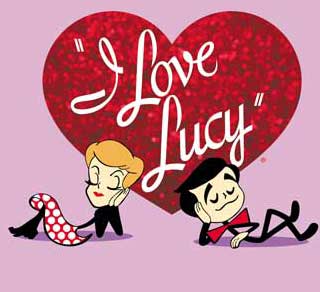
Recalled as an exceptionally humorous sitcom,
I Love Lucy was the #1 most watched program on TV from 1952 to 1955 and, again, from 1956 to 1957. The television sitcom reached its apogee in popularity with the January 19, 1953 episode, "Lucy Goes to the Hospital," a program watched by 72 percent of all TV households, a then-record not even surpassed by President Dwight Eisenhower's inauguration the following day. This episode was an apt reflection of a unique defining characteristic of the show in that the storyline and plot was largely consistent with the real life of the show's stars, Lucille Ball and Desi Arnaz. The episode depicts Ball's character, Lucy Ricardo, giving birth to a child while - on the same exact day - Ball herself gave birth to Desi Arnaz, Jr. However, the most glaring similarity between Ball's real life and her character in the show was that Desi Arnaz, who portrayed Lucy Ricardo's husband Ricky, was actually married to Ball. Indeed, much of the popular sitcom represented a mirror image of reality. For instance, the real-life marriage of Ball and Arnaz was notably rocky and contentious, shaken by Ball first filing for divorce in 1944 - yet pulling back soon thereafter - and consumed with arguments surrounding Arnaz' party-embracing personality. In the sitcom itself, the Ricardos often engage in argument, albeit largely comical exchanges. For example, in the episode "Lucy and Superman," Lucy's efforts to dress up like Superman for Ricky's birthday party backfire when George Reeves - who played the TV role of Superman at the time - shows up to the party. The resulting events culminate in Ricky angrily suggesting that Lucy embarrassed him.
The on-screen marriage of Lucy and Ricky's landlords, the Mertzes, was also defined by occasional arguments. In real life, the relationship of the actors who played Mr. and Mrs. Mertz - Bill Frawley and Vivian Vance, respectively - was extremely contentious. The two actors reportedly despised each other so much so that when Frawley passed away in 1966, Vance is believed to have said, "Champagne for everyone!" Their mutual hatred was reflected in incidents such as Frawley calling Vance "a sack of doorknobs" and Vance protesting that Frawley's old age was a detriment to his abilities on stage. In spite of off and on screen arguments, the show's hilarity and comic brilliance made it a huge hit. The sitcom's funniest episodes include "Lucy Does a TV Commercial," a program in which Lucy becomes drunk while filming an advertisement for a bizarre medication. The episode was ranked as the second greatest TV episode of all time by
TV Guide, a publication which also listed
I Love Lucy as the second greatest TV show ever. The show has earned numerous other accolades for its humor as well, including the Emmy for Best Situation Comedy in 1953 and 1954 and a spot on
Time magazine's 100 best TV shows ever.
SOURCES:
1. Wikipedia - "Nielsen ratings"; en.wikipedia.org/wiki/Nielsen_ratings
2.
www.tvhistory.tv/facts-stats.htm 3.
www.lucyfan.com/ilovelucy56.htm4.
The Fifties, David Halberstam. 1993.
5. Lucille Ball & Desi Arnaz - February 12, 1996 - People.com
6.
www.tv.com/i-love-lucy/lucy-and-superman/episode/17263/summary.html7.
Desilu: The Story of Lucille Ball and Desi Arnaz, Tom Gilbert. 1993.
8. The Internet Movie Database -
I Love Lucy (1951-1957);
www.imdb.com/title/tt0043208/9. The Museum of Broadcast Communications -
I Love Lucy; www.museum.tv/eotvsection.php?entrycode=ilovelucyPICTURES:
1. Timstvshowcase.com (
The $64,000 Question)
2.
www.jimis-cyberstore.com/store/media/i-love-lucy-tshirt-115b.jpg (
I Love Lucy)
 After WWII, the world of sports began to go under rapid changes. Sports were becoming more racially integrated and were now even beginning to broadcast on live television. In the late 1940s, leading into the 1950's, baseball was the biggest sport to go through these changes.


