Sunday, April 10, 2011

"Talking Spirits" and "Sex in a Box"

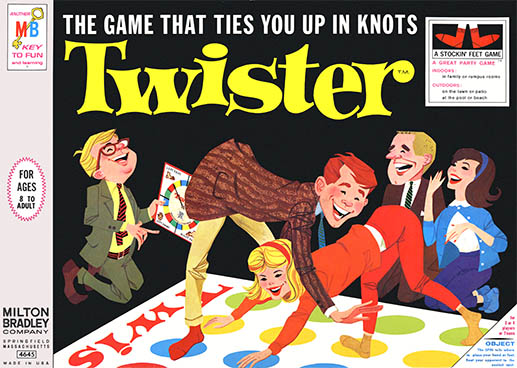
The 1960's was a historic decade for board games. With the advent of children spending more money, board game manufacturers upped their ante by producing more increasingly more creative games. Board games such as Twister and Ouija were invented in the 1960's and are still sold today.

Twister was a sensation in the 1960's. Such a sensation that competitors were calling it "sex in a box". The controversial game was the first board game to make use of someones entire body. For the first time there was a party game where the only pieces to it were your body. The game was even more of a sensation at college campuses. As more teenagers were experimenting with drugs such as marijuana and LSD they were also experimenting with their bodies. Twister enabled teens to experiment with their bodies in a seemingly "harmless" way. When the game was featured on late night talk shows like Johnny Carson's show the game became a household name. The game was so simply designed that manufacturer Milton Bradley could produce it at such a low cost and produce even larger profits. Because of the games low production costs Milton Bradley spend large amounts of money marketing the game. After the game became extremely popular, people were seeing the games potential "sexual connotations". Since these "connotations" were essentially true many retailers such as Sears began to take the game off their shelves. This game was so revolutionary for its time that not just kids were having fun with it but so were adults. A simple game that was fun for both parents and kids sent shockwaves in the board game industry.

Another revolutionary board game that was released in the 1960's was the Ouija board. Less of a game and more of an experiment, the Ouija board continues to "connect" people to the "spirit world" to this day. The board is "supposed to" let you communicate to the spirits of the dead by just asking them any question. The game is played by two players placing their fingers on planchette, then they ask the "spirits" a question which they are seeking an answer too. The spirit supposedly answers by spelling out its answer on the letters printed on the Ouija board. In able for the effect to work the players must "believe" that the board truly works. After many years of scientific research the spirits are no other than something called "ideomotor effect". This is a "psychological phenomenon wherein a subject makes motions unconsciously" and thus causes the planchette to move around the Ouija board. The Ouija board is still around today despite it being debunked by the scientific community.

Since both of these board games are still being sold today I think it testifies just how creative and revolutionary they are. Most board games come and go but these two are such classics that will probably be continued to be sold for decades to come.

Image Credits:

How To's:

Twister

Ouija


The Beatles Come to American TV

Although heavily popular in Britain by 1963, The Beatles had not made a significant splash in American culture yet. However, soon thereafter, a nation already captivated by bands like The Beach Boys would be introdued to a phenomenon that ultimately whetted the musical appettite of Americans across the country. While the band did not formally leave Britain until February 7, 1964 -- a departure famously marked by the sight and sound of four million adoring fans gathered at the Heathrow Airport -- their premiere on American television predated this exit from the U.K. Contrary to popular belief, The Beatles' seminal appearance on the legendary The Ed Sullivan Show was not their first time hitting TV screens across the United States. Indeed, The Beatles' premiere on American television was in an interview with another consequential figure in TV history, Walter Cronkite.


"We were offered a piece [on The Beatles] from the London Bureau," Cronkite recounted prior to his passing, "and so we put it on the air one night and we were hardly off the air yet and Ed [Sullivan] was on the phone with me and he said to me, 'Walter, tell me about those kids! What do you call them? The Bugs or something?'" Cronkite, the longtime revered anchor of CBS Evening News, conceded that the fact that The Beatles were interviewed on his program prior to Sullivan's show is a "little known fact. " On December 10, 1963, The Beatles were interviewed in a piece from London on CBS Evening News regarding their music, massive popularity in England, and even their hairdos. Opening with a clip of the group performing the hit "She Loves You," this piece on The Beatles depicted John Lennon, Paul McCartney, George Harrison, and Ringo Starr as "Britain's latest musical and...sociological phenomenon." The CBS News journalist covering the story told viewers that the musical sensation attracted "thousands of teenagers in every city stand[ing] in line for tickets." In a telling harbringer of soon-to-be American Beatlemania, the piece told viewers of "adoring fans" and "girls fainting when tickets" were sold out in Britain. In the interview that followed, The Beatles provided stereotypically cunning and tight-lipped answers to a reporter's questions. For instance, when asked to explain The Beatles' popularity, McCartney jokingly insisted it can be attriubuted to their "haircuts" and suggested that it was "to stupid to worry about" fans becoming "tired" of their music. Soon thereafter, Ed Sullivan reached a handshake agreement with Beatles manager Brian Epstein at the Hotel Delmonico in New York to have The Beatles play for $10,000 on his show-- an occurrence that Cronkite said he hopes he gets some "credit" for in the annals of music history.


Despite Walter Cronkite's desire for 'credit,' it is still widely believed that the first time The Beatles appeared on American television screens was in their appearance on The Ed Sullivan Show. Nevertheless, Sullivan did help popularize The Beatles as his show was a cultural staple that provided a uniquely opportune platform for musical giants like Elvis Presley and Buddy Holly in the 1950's. While not their first time on American TV, The Beatles' three consecutive visits to Sullivan's stage marked the group's first live American TV appearance and was the first time their music has been exposed to a significantly large U.S. audience: 73 million viewers, record viewership at the time. Coming on the heels of their arrival in the United States merely days earlier, the February 9, 1964 visit on The Ed Sullivan Show included the performance of such hits like "I Want to Hold Your Hand," a song already topping U.S. record charts. Leaked to U.S. radio audiences against the wishes of Capitol Records in December 1963, "I Want to Hold Your Hand" catapulted to almost overnight success, selling 250,000 copies within three days and attaining the #1 position on the Billboard by late January 1964. Other than "I Want to Hold Your Hand," other songs included in the three consecutive Beatles appearances on Sullivan's show were "I Saw Her Standing There," "She Loves You," "Please Please Me," and "All My Loving," among others. These tunes rocked Sullivan's live and at-home audience. In his studio, Sullivan -- slightly annoyed by shrieking girls -- urged fans to "keep quiet" and was forced to keep seating limited to a 700-seat capacity in spite of 50,000 requests for seats, including from ex-Tonight Show host Jack Parr and Cronkite. At home, Americans would grow accustomed to a band they began to fall in love with by 1964 so much so that when The Beatles appeared on Sullivan's show a year later, in the fall of 1965, that broadcast earned Sullivan a 60 percent share of the entire nighttime TV audience. Ultimately, these audiences and the embrace of The Beatles that they displayed was undeniably aided by both Walter Cronkite and Ed Sullivan in familiarizing Americans with the British band's music and style.


SOURCES:


1. Wikipedia - 'The Ed Sullivan Show,' http://en.wikipedia.org/wiki/The_Ed_Sullivan_Show

2. The Official Ed Sullivan Site: Classic Entertainment for a New Generation - The Ed Sullivan Show - The Beatles, http://www.edsullivan.com/artists/the-beatles/

3. CBS News.com - CBS Evening News with Katie Couric - Walter Cronkite: 1916-2009, "The Beatles' First Time on American TV," http://www.cbsnews.com/stories/2009/07/18/eveningnews/main5172519.shtml

4. YouTube - 'The Beatles, first time on U.S. TV", http://www.youtube.com/watch?v=G6j5bve7O5E


IMAGES:


Sunday, April 3, 2011

The beginning of the credit card

The Diner's Club Card was the next step in credit cards...


It all began in 1949 when a man named Frank McNamara had a business dinner in New York's famous Major's Cabin Grill. As soon as the bill arrived, Frank realized that he did not have any cash in his wallet. He ended up paying the bill, but he decided that there should be an alternative to cash. Frank and his partner, Ralph Schneider, returned to Major's Cabin Grill in February of 1950 and paid the bill with a small, cardboard card. This "card" was known as the first Diner's Club Card.


In 1950, around 200 of these cards were given out to various people such as friends and acquaintances of Frank. The progress of the cards was very difficult and there were only 14 restaurants in New York that accepted these cards. Most merchants did not want to pay the Diner's Club's fee and didn't want competition for their own store cards. Also, customers didn't want to sign up unless there were a large number of merchants that accepted the card. But, that didn't stop the card from growing.


By 1951, there were 20,000 Diner's Club cardholders. In only its second year, the Diner's Club made a profit of $60,000. McNamara had started a company that would reshape the way customers make purchases. At the time, he didn’t seem to think it was anything special or lasting, so he decided to sell his shares in the company to his two partners for $200,000. Not even a decade later after McNamara sold his shares, the card had now been replaced with a plastic card. At this time, Diner's Club Card purchases were made on credit, but it was technically a charge card, meaning the bill had to be paid in full at the end of each month. In order to make a profit without charging interest, the companies who accepted the Diner's Club credit card were charged 7 percent for each transaction, while the subscribers to the credit card were charged a $3 annual fee. With no competition until 1958, the Diner's Club Card continued to grow more and more popular. The idea of a universal credit card that would change the world had now begun to spread across the world.

Now Jim Brown


Jim Brown was born February 17, 1936 in St. Simon Island, Gerorgia. Jim is an American icon and perhaps one of the greatest running backs to ever play the game of football. Jim was also known as an actor and a civil rights activist. Jim participated in many different sports at the University of Syracuse. He earned thirteen letters in college playing football, baseball, basketball, lacrosse and running track. Initially because of his race Jim did not receive an athletic scholarship. However a benefactor paid for Jim to attend the university. Jim showed outstanding athletic ability and became an All-American in football and lacrosse. Due to racism Jim was the only black player on the team and was only allowed to play football his senior year.


Jim started playing for the Cleveland Browns in 1957. He immediately became recognized due to his combination of speed and athletic ability. Brown was a huge threat and could score a touchdown from any part of the field. Jim ran for over 1,000 yards seven out of his nine seasons and scored 106 touchdowns in his career. Brown retired at the age of 29 to become an actor. In 1971 he was abducted into the hall of fame.


Everytime Brown would play in a southern stadium the fans would boo him and throw things at him because he was black. Jim did not let the fans effect him though. Jim beleived that even if people did not like him because of the color of his skin that the most important thing was to play to his fullest and not let his team down.


Jim continues to work to this day to remain active in and support Civil Rights groups.


Sources


Game Shows and Scandals


With the exception of the early 2000's -- which saw the massive popularity of Who Wants to Be a Millionarie and copycats like Greed -- primetime television game shows have largely been a relic of the past since the early 1970's. In fact, The Encyclopedia of TV Game Shows: Third Edition recounts that from the fall of 1971 to August 1999 when Millionaire premiered, there were virtually zero regularly scheduled primetime network TV game shows. However, this reality was not the case during the 1950's, an era in which several primetime network game shows were incredibly popular. These game shows inclued Groucho Marx's You Bet Your Life, Strike It Rich, I've Got a Secret, What's My Line?, Name That Tune, and the original, Bill Cullen-hosted version of The Price is Right. Many of these game shows - including Price is Right, What's My Line?, and I've Got a Secret - owe their success to the genius of Mark Goodson. Goodson, who worked alongside Bill Todman in many of these programs, was the chief producer - and sometimes, creator - of several game shows of this era. The brilliance of Goodson and Todman (pictured left) was seen in the coming decades as well with the success of Password and Match Game in the 1960's and 1970's, respectively. While these game shows were very fascinating and popular, programs like The $64,000 Question and Twenty-One were nevertheless plagued by scandal.


Question, emceed by host Hal March and so highly viewed that President Eisenhower hesitated to schedule speeches during the show's time slot, revolved around the concept of one contestant continually playing for escalating amounts of money. Upon the start of an episode, a contestant would pick a category and be asked questions pertaining to this category. If the contestant answered the first question - worth $1 - correctly, he or she could win double the amount of money, or $2, by answering the next question correclty. If the contestant consistently, without fault, correctly answered question after question thereafter, he or she can keep doubling his cash winnings with each right answer. If a contestant correctly answered 17 consecutive questions, he or she would win the maximum cash prize of $64,000. The exhiliration of the show was especially high when the contestant was placed in a soundproof isolation booth - dawning "Revlon," the show's sponsor, at the top - at the $8,000 level where he or she can only hear the sound of the host. At any point, a contestant could quit and leave with his or her earned money but if a contestant answered a question incorrectly after the $8,000 level, he or she would walk away with no money but a consolation prize instead.


The popularity of The $64,000 Question was never in question -- no pun intended. In fact, the first contestant who won the show's $64,000 top prize - Richard McCutchen - became an almost universally well-recognized national icon. Viewership was so high that the quiz show became the #1 most watched show on TV in the 1955-56 season, according to the Nielsen ratings system. Nevertheless, merely two years later, the show fell in an embarassing demise. After changing its name to The $64,000 Challenge, the game show's practices were exposed in a federal grand jury when contestant Rev. Charles Jackson conceded he had been notified of answers to questions prior to going on air. Jackson's revelation was part of a broader stain on the reputation of the show as it was soon revealed that many of the categories and questions used in the show were explicitly selected to appeal to the speciality or interests of a contest that sponsor Revlon liked. Revlon's unethical practices extended further as the sponsor tried to do what it can to make the questions exceptionally difficult for contestants who Revlon saw as uninspiring and uninteresting. By November 1958, scandal took the show off the air.

A similar story unfolded with the popular game show, Twenty-One. This quiz show, hosted by Jack Barry, featured more complicated rules than The $64,000 Question. Two contestants, both placed in isolation booths, were given the objective of earning a total of twenty-one points, the number necessary to advance to the next episode and to continue winning money. If a contestant answered a question correctly, he or she would earn more points but an incorrect answer meant points were deducted from the score. The contestant would pick the point value of the question, ranging from one to eleven points, yet there existed a reality that a higher point value meant the question was more difficult. If a contestant successfully earned 21 points at any time during the episode - without the opponent consequently being able to tie that score - he or she would win the game and play a new challenger in the next episode. However, there was somewhat of a twist. After merely two categories, a contestant could choose to stop the game and whoever was ahead would win regardless if he or she was at 21 -- but neither contestant would know the other one's score as they were both in isolation booths.


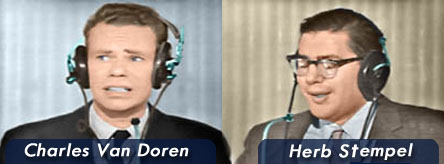
Of all the shows that were hit by scandal in the 50's, the most well-known case was that of Twenty-One. This scandal - portrayed in the Oscar-nominated 1994 film Quiz Show - revolved around contestant Charles Van Doren. Van Doren, a contestant producers considered an"All-American Boy," told a U.S. House committee investigating quiz shows that he was told the answers to all of the questions on the show by the producers before each episode he appeared on during the program's tenure. The revelation was particularly stinging as Van Doren was a long-running contestant on Twenty-One, winning cash on a seemingly endless array of consecutive episodes and continually beating opponents week after week to advance. His consistent success on Twenty-One landed him on the cover of Time magazine. His supposed intelligence and mastery at questions also earned the adoration and amazement of TV viewers who briefly dethroned I Love Lucy's spot at the top of the ratings in favor of watching Van Doren. However, his victories were a sham all along. Producers desperate for ratings did the unimaginable: they successfully urged previous continual show winner Herbert Stempel to answer a question about the 1955 Academy Awards incorrectly so that Stempel's more attractive opponent, Van Doren, could win the match and advance.


However, since this time, trust in the institution of TV game shows has long been restored as these scandals have become part of history. No longer are contestants' large winnings ever questioned as part of a broader conspiracy. When John Carpenter became the first contestant to win $1 million on Millionaire in 1999, there was little to zero suspicion. In 2004, when Ken Jennings successfuly won over $2 million after 74 consecutive days of winning, the same lack of suspicision existed. The era of the quiz show scandal is no more.


Sources:

1. The Encyclopedia of TV Game Shows: 3rd Completely Updated Edition,1999. David Schwartz, Steve Ryan, and Fred Wosthrock.

2. The American Experience: The Quiz Show Scandal, www.pbs.org/wgbh/amex/quizshow/filmmore/transcript/index.html

3. Quiz Show, Robert Redford, 1994.

4. Internet Movie Databse (imdb.com), The $64,000 Question.


Pictures:


3D? Drive-Ins? Is this 1950 all over again?


It is truly amazing how many entertainment fads came out of the 1950's. With such new ideas such as drive-in's and 3D-Movies the 1950's set the bar high for entertainment technology. So many new concepts like these arose out of this era. So many things that we have become accustom to or even forgotten about came from the 1950's.

Although drive-in theaters were around before the 1950's the technology wasn't popularized until the 1950's. The idea was simple. People would drive their cars into the theater and watch the movie on a big projector screen while listening to audio in the comfort of their own car. In the 1950's drive-ins were everywhere. These theaters were only really available in rural areas but some people who lived in large cities were often eager to experience them when they went to friends houses in the suburbs. In the 1950's there were about 4,000 drive-ins which were spread across the nation. The revenue at these theaters were often lower than a normal theater due to the fact that they could only have showings at nighttime. Teenagers of the time were frequent customers of these new theaters, especially in the summer months. They were often notorious for smuggling their friends in trunks to avoid admission fees. This and a multitude of other factors led like color TV and video rental led to the demise of drive-ins. For its time it was a great idea as more and more people were owing cars in this country. Although they aren't very popular anymore there are still a small number of drive-ins in the United States with a few even in our area. These drive-ins have been getting poplar again as more and more "guerrilla" drive-ins are popping up all over the country. It will be exciting to see if this trend catches on again.

Like the drive-ins, 3D movies weren't invented in the 1950's but certainly became popular within that era. The first 3D movie premiered in 1922 in LA. The format saw literally no interest in the 1930's and 40's mostly due to the Great Depression and WWII. After these major historical events Americans began to spend more money on entertainment. This increased the number of 3D films being produced. 3D movies in the 1950's were extremely popular but also extremely hard to present. In the 1950's they had to produce two separate rolls of film and they both had to be played in sync with each other to achieve a positive experience. Because of the negligence of some projector operators some of the film critics gave negative reviews to the new technology
because of how "hard on the eyes" it was. This problem was eventually fixed in the 1960's with the invention of single-strip 3D films but because films from that decade were so bad the technology eventually disappeared from cinema until the 2000's.

The 1950's was a decade full of exploration. Lots of new ideas and technologies emerged from this decade because of the vast amount of exploration that was occurring. I think that this exploration really showed itself in the entertainment industry. That's where you could really see its impact. The 1950's paved way technologically for future generations. It gave us a glimpse of how advanced technology could become if there was enough money to back research for it. I am truly amazed at how much technology was invented and popularized during this decade. So amazing in fact that this technology is becoming popular again.

http://www.adrowe.com/
http://jhammer.blogs.ocala.com/

Sources:


Sunday, March 27, 2011

Baseball-America's true pastime


After WWII, the world of sports began to go under rapid changes. Sports were becoming more racially integrated and were now even beginning to broadcast on live television. In the late 1940s, leading into the 1950's, baseball was the biggest sport to go through these changes.


Before WWII, there had never been a black baseball player in the history of the game. There were certain leagues set up for all of the black players, due to the racial barrier between white's and blacks at the time.One man would change it all.


In 1947, Jackie Robinson not only changed the face of baseball, but he had changed America. With extreme pressure and hatred of many players and fans, Robinson became one of the most amazing performers in the game. He had paved the way for other black stars such as Willie Mays and Hank Aaron. The integration in baseball, that was put in place by Robinson, became a fact of baseball life so quickly that by the mid-1950s there were more African-American players on major league teams than there had been in the Negro leagues at their height of popularity just a decade earlier. Jackie Robinson had broke the racial barrier that had been in place for years. He did something that exceeded all odds at that time and changed the way baseball is today.


video wouldn't upload, so here is the link
http://www.youtube.com/watch?v=_l8-r3s32ys
 
Copyright © The Bird is the Word
Blogger Theme by BloggerThemes Sponsored by Internet Entrepreneur